
Copy Trading Risk Controls: A Control Framework for Providers, Followers and Execution
Copy trading couples one provider’s behaviour to many accounts, so failures propagate. A control framework organises protections by where the risk arises: provider, follower and execution, with monitoring and response on top.
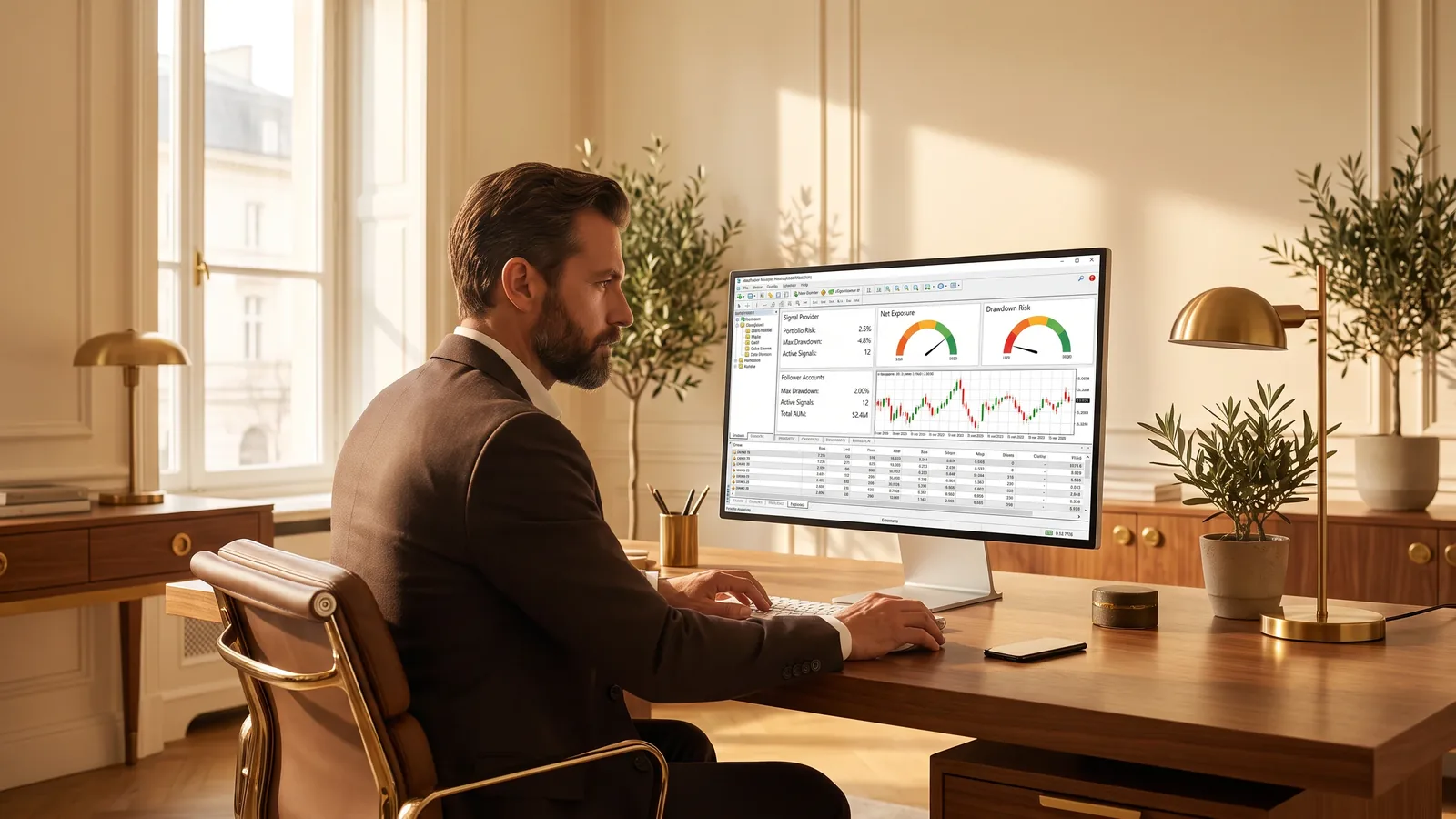
Provider controls
- Onboarding checks and acceptance of terms.
- Limits on leverage, lot size and instruments.
- Behavioural monitoring for sudden changes in style or risk.
- A defined procedure and authority to pause or remove a provider.
Follower controls
- Maximum lot size and total exposure.
- Equity or drawdown stop that pauses copying.
- Option to stop copying at any time.
- Safe defaults, because many followers never change them.
Execution controls
Define the maximum acceptable delay and slippage between provider and follower orders, and the action on breach: skip, delay or execute. Define behaviour when margin is insufficient and when the provider closes a position during a delay.
Monitoring
Monitor copy lag, rejected orders, drawdown events and concentration in a single provider. Alert on thresholds and review them daily at launch and weekly after.
Fee and disclosure controls
Calculate fees consistently, show them before a follower commits and on statements, and store the risk warnings shown with timestamps.
Incident response
Document who can pause a provider, how followers are notified and how the cause is recorded. Rehearse it once. See configuration details in the account setup specification.
Metrics for the control framework
- Average and maximum copy delay.
- Share of follower orders rejected or skipped.
- Number of drawdown pauses triggered.
- Concentration: followers per provider.
- Time to pause a provider.
Review them weekly, set thresholds and record every threshold breach with its outcome.
Control framework by layer
Organise controls in layers: provider admission, provider behaviour, follower protection, execution quality, fee integrity and incident response. For each layer, list the control, the parameter, the monitoring signal, the owner and the action at breach. A control without a signal and an owner is a policy statement, not a control.
Map every control to a risk statement so that coverage gaps are visible.
Control specification table
| Control | Parameter | Signal | Owner | Action |
|---|---|---|---|---|
| Exposure cap | Max lots or notional per provider | Real-time exposure | Risk | Reject new copies |
| Drawdown pause | Threshold per follower | Equity vs peak | Risk | Pause and notify |
| Concentration | Max followers per provider | Count | Product | Block new followers |
| Delay limit | Max copy latency | P95 latency | Operations | Alert, investigate |
| Fee integrity | Ledger reconciliation | Differences | Finance | Correct and notify |
Store the table as a controlled document and test each row.
Execution quality monitoring
Measure the time and price difference between provider order and follower fill, the share of skipped or rejected copies and the distribution of slippage. Compute by symbol and by session. Investigate outliers and trends.
Define fairness rules: how partial fills and rejections are allocated among followers, and document them in disclosures.
Incident response and disclosure
Write playbooks: provider breach, platform outage, mispriced fee, data error. Each playbook lists detection, containment, communication, remediation and review. Prepare message templates. Rehearse one playbook per quarter.
Disclosures should state risks, fee mechanics, limit behaviour and the process for stopping copying. Review them with qualified advisers for each market. See our setup guide for configuration.
Worked example: a drawdown pause
A follower sets a drawdown threshold of 15 percent. A provider’s sequence of losses takes the follower’s equity to 14.8 percent below peak at one check and 15.4 at the next. The system pauses copying, notifies the follower and records the event. Open positions follow the defined policy (hold, close or provider-managed).
Test this with numbers, including the interval between checks and what happens to orders in flight. Disclose the policy so followers understand what a pause does and does not do.
Control effectiveness review
Quarterly, review control events: breaches, pauses, overrides and false alarms. Tune parameters, retire noisy alerts and add controls where incidents revealed gaps.
Record each review with date, participants and changes so that the control framework has a documented history.
Governance and accountability
Assign accountable owners for the control framework, for provider admission decisions and for incident response. Define committees or review points: for example, a weekly operations review and a monthly risk committee that considers breaches, exceptions and changes.
Minute decisions, particularly overrides and exceptions, and track them to closure. Accountability for exceptions is where control frameworks most often weaken.
Frequently asked questions
What makes a control effective?
A parameter, a monitoring signal, an owner and a defined action at breach.
Which execution metrics matter?
Copy latency, price difference, skip and rejection rates and slippage distribution.
How should incidents be handled?
With playbooks covering detection, containment, communication, remediation and review.
How often should controls be tested?
On every change and on a regular schedule such as quarterly.